Improving Employability with Belbin

Helping People Understand and Demonstrate What They Bring to a Role

Belbin Updated CV Employability

Qualifications and experience may help get a candidate onto the shortlist. What gets them the job, and helps them succeed in it, can sometimes be harder to evidence: how they behave, how they work with others and what they contribute to a team.

Employers may ask about this on application forms, at interview and during probation, yet candidates are often unable to clearly and credibly demonstrate this.

This can be even more important for pre-workforce or early career stage candidates, who may have limited or no previous work experience to call upon.  

Belbin Team Roles Reports help to close that gap. They give individuals a practical language for describing their behavioural strengths, understanding their weaknesses and a way of connecting these attributes to the roles they apply for.

Reports can help give careers advisers, colleges, employability service providers and employers a shared framework and behavioural language for describing and further developing these qualities in the people they support.

What Employers Are Looking For

Almost every job advertisement lists the technical or competency requirements.

The person specification typically includes a second set of behavioural requirements.

Employers are often seeking new recruits who can communicate effectively, work well in a team, show initiative, solve problems and adapt to change. All are behaviours which can be measured effectively using Belbin Reports.

Skills Development Scotland refer to these as meta-skills on their World of Work website, and many employers will evaluate them alongside technical ability when recruiting or promoting.

Behavioural qualities are often easy to claim but sometimes harder to prove.

“I am a good team player” appears on almost every CV, and interviewers can easily discount it.

What can be much more persuasive to a prospective employer is directly relevant, specific, behavioural evidence:

  • The particular contributions someone makes in a team
  • Where they know they can perform to the best of their ability
  • The honesty to acknowledge where they may be lacking

Belbin describes behaviour not personality in the context of how someone contributes to a team.

That can make it much easier for a prospective candidate to explain their behavioural skills in a way that directly translates what employers are seeking.

The end result?

Quite simply, it can help increase the chance of hiring success.

Employability - Contribution, Not Just Credentials

Belbin Individual

Belbin Reports can help distinguish between a person’s functional role – their job title and technical duties – and their Team Roles – the behavioural contributions they make when working with others.

Two candidates with near identical qualifications or experience can contribute to a team in very different ways.

Someone applying for an apprenticeship, a graduate scheme or a first role in a new sector may more naturally:

  • Generate original ideas and fresh approaches as a Plant
  • Explore opportunities and make external contacts as a Resource Investigator
  • Bring people together and draw out their contributions as a Co-ordinator
  • Provide drive and challenge to keep things moving as a Shaper
  • Weigh up options objectively and make sound judgements as a Monitor Evaluator
  • Support colleagues, listen well and ease friction as a Teamworker
  • Turn plans into practical action and reliable routines as an Implementer
  • Check details, meet deadlines and maintain quality as a Completer Finisher
  • Bring depth of knowledge and technical skill as a Specialist

Every one of these attributes can be “in-demand” qualities employers are looking for.

Knowing the behavioural skills they bring can help turn a vague “I’m quite organised” statement into something you can describe, evidence and offer;

“As you will see from my Belbin Report, I have excellent organisational skills and a strong natural ability to turn ideas into practical working solutions.”

Sound better?

Backed up with some evidence as well, not just self-opinion.

Where Belbin Fits - Stages of Employability

Team Problems - High Performing Teams

For school leavers, college and university students, typically from age sixteen to mid-twenties, the Belbin GetSet Report is a natural starting point.

It uses the same Team Role framework as the full Belbin reports but presents the results in a practical workbook format designed for people with limited or no workplace experience.

Practical supporting materials are available for use by teachers, lecturers,  employability support and apprenticeship providers.

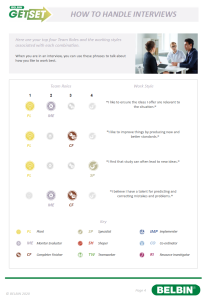
The GetSet report helps students and candidates understand the roles they play in team context and can give greater understanding of their behavioural skills, using professional language to describe these to include in their personal statements, CVs and interview answers.

For use for apprenticeships, internships and placements or for students or early career job seekers,  Team Role awareness can help the application process and make the early stage of any paid or unpaid employment in a workplace easier.

For example, an apprentice who knows they are a strong Completer Finisher can see why they can be trusted with the details, and why they may need to push themselves forward more.

For graduates and early-career professionals, competency-based applications, assessment centres and structured interviews all usually seek candidates with more defined behavioural capabilities.

The Belbin Individual (Self-Perception) Report helps to specify this more effectively. 

Both GetSet and the standard Belbin online questionnaire take only around 10 to 15 minutes to complete.

Reports set out preferred Team Roles, strengths and allowable weaknesses in language that transfers easily and directly into a typical STAR type interview format answer.

For people starting their career, returning to work after a period away from the workplace or people facing redundancy, Belbin reports can be highly valuable.

Team Roles are also not tied to specific roles, seniority level, sector or industry.

A strong Co-ordinator who may have spent fifteen years in hospitality can bring the same level of Team Role contribution to a new or different role or career.

Being able to identify and name that contribution can greatly assist the job search, application or career change process, and become a turning point in career transition.

Within an outplacement programme, an Individual Report with optional Observer feedback from former colleagues can provide the departing employee with an even more robust and objective account of their strengths to prospective employers.

Building Self-Awareness: The Starting Point

Belbin self awareness

Every application of Belbin, including employability,  begins with increased behavioural self-awareness.

The GetSet or Belbin Self-Perception questionnaire asks how the individual sees their own behaviour. 

The reports set out their preferred, manageable and least preferred Team Roles, along with the associated strengths and allowable weaknesses of each.

Having a proper understanding of strengths and allowable weaknesses can make a real impact in an employability context.

Belbin’s theory talks about every Team Role strength having corresponding weaknesses – some allowable, some non-allowable. 

Understanding this properly helps candidates explain and manage this, rather than gloss over or hide it.

  • A Plant who generates original ideas may be more prone to overlooking practical details
  • A Shaper who provides drive and determination may be impatient with slower colleagues.

Understanding this, with the right support, can really help candidates answer key interview questions like “What are your strengths?” or “What would you say is your main weakness?” with honesty, composure and greater confidence. 


From Self-Awareness to Employability

Understanding What Employability Success Really Requires

The Right Career Path 

Choosing the right direction in an early stage career can be very important.

Many people apply for roles that suit their qualifications or experience, but these may not always suit their behavioural style.

Team Role awareness helps people think about the work in which they are likely to thrive:

  • A Specialist may be drawn to depth and technical mastery
  • A Resource Investigator to variety and external people contact.


This should not rule roles out, since almost every job draws on a range of Team Roles, but it may help with a more focused approach to job applications by applying to roles that could be a better fit. 

Belbin Businesswoman
Belbin Employability CV

Writing a stronger CV. 

A CV built around tasks may tell an employer what someone was responsible for. 

A CV which includes team role behaviour helps inform them what that person could bring to a team. 

Our guide to enhancing your CV with Belbin Team Roles covers this in much more detail.

Performing well at interview. 

Most interviewers may want to know how a candidate may behave if recruited for a job. 

A candidate who understands their Team Roles can evidence this more directly, with key examples chosen to highlight their strengths.

Our guide to improving your interview technique with Belbin sets out how, including the weakness question and the STAR method.

Belbin Interview Meeting Recruitment
Belbin Employability CV

Succeeding in the first role. 

Probation periods, apprenticeship reviews and graduate placement rotations may all contribute to the assessment of how well someone is contributing to a team.

Someone who understands their strengths, and can discuss them with their manager, may integrate faster and may be more likely to be retained.

Our page on onboarding effectively with Belbin covers this element from an employer’s perspective.

The Belbin Job Profile in Employability

Belbin Task List

One of the most useful applications of Belbin in the context of employability is looking at the requirements of the job not just the person.

The Belbin Job Profile Report identifies the behavioural contributions a specific role actually requires. It is produced by completing the Job Requirements Inventory, completed by the manager or recruiter, with optional input from colleagues who know the role well.

The results the report generates are often different from what the job description might imply.

For employers, it helps clarify what they are really recruiting for.

A role seeking a “dynamic self-starter” may actually need a reliable Implementer far more than a Shaper.

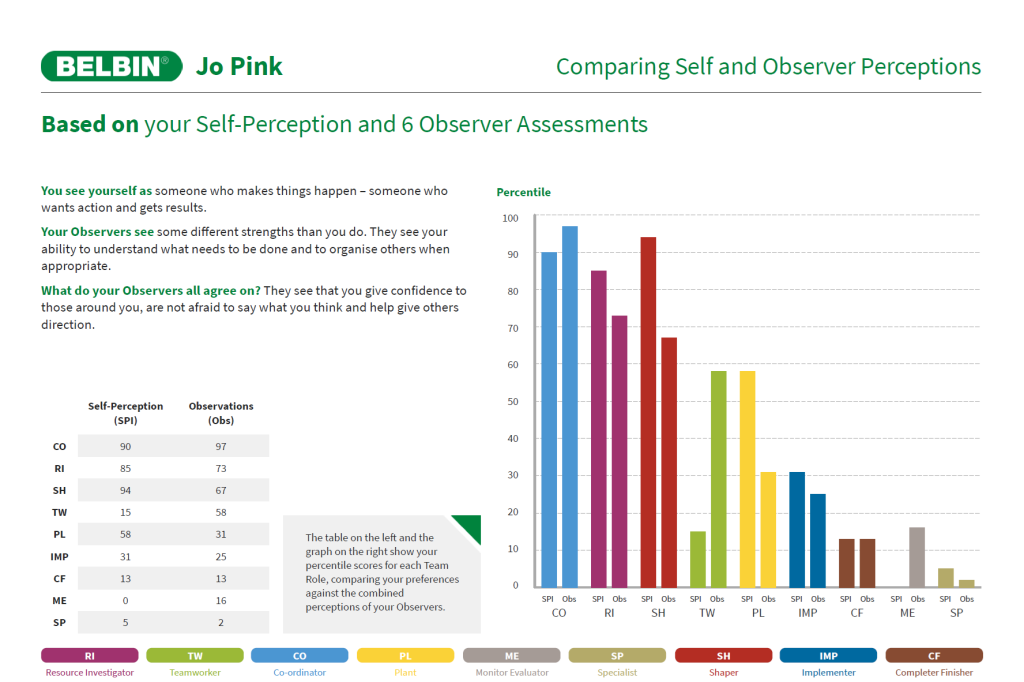
A Belbin Job Comparison Report compares a candidate’s profile alongside the role’s requirements, showing where strengths align, where support may be needed and where the candidate may need to adapt.

This should only ever be used to help inform a recruitment decision, never as a final decision in itself, and reports should never be used on their own to eliminate candidates from a selection process.

For careers advisers and employability providers, Job Profiles of typical entry-level roles, placements or apprenticeships can also help give participants a realistic picture of what those roles demand behaviourally. They can allow for a far more informed conversation about which opportunities may suit different people.

For individuals, knowing what a role requires can also transform the way they prepare for it:

A candidate who knows a role needs strong Completer Finisher and Teamworker contributions can prepare examples that demonstrate exactly that, or perhaps recognise that a different role may suit them better.

Belbin and Scotland's Meta-skills

Belbin New Start Employee

Skills Development Scotland’s meta-skills framework is language commonly used to support employability across Scottish schools, colleges, apprenticeships and employer programmes.

It describes twelve meta-skills under three headings:

  • Self-management (focusing, integrity, adapting, initiative)
  • Social intelligence (communicating, feeling, collaborating, leading)
  • Innovation (curiosity, creativity, sense-making, critical thinking).

The Meta-skills and Belbin frameworks are complementary and help understand and describe what people need to further develop.

They help explain how each individual is naturally inclined to demonstrate Behaviours / Team Roles and where they may need to work on these skills.

Collaborating and feeling relate well to Teamworker and Co-ordinator style behaviour.

Initiative and adapting behaviour are characteristic of Resource Investigators and Shaper styles

Focusing and integrity are aligned to the strengths of Implementers and Completer Finishers

Curiosity and creativity fit well with the tendencies of the Plant.

Finally, sense-making and critical thinking are where Monitor Evaluators and Specialists might excel.

Mapping Belbin to Meta-skills is intended as a starting point not a formula for success, as each meta-skill could be demonstrated through more than one Team Role trait.

The real value comes from using Belbin in conjunction with meta-skills, to help personalise their development:

Each individual can see more readily which meta-skills come naturally, which they may be underestimating and which may take deliberate effort, and can ultimately better evidence these in a CV or interview.

For Advisers, Providers and Employers

Belbin Advisor

Belbin can work particularly well in group settings where much employability support can be delivered.

A facilitated session with a class, an apprentice cohort or a programme group typically covers the nine Team Roles, each participant’s own profile and a practical exercise in which the group experiences the difference a balance of contributions makes.

Participants leave with a report they can use immediately and a shared behavioural language that remains useful throughout a programme and beyond, carrying into the workplace to good effect.

GetSet draws examples from school, college, sport, volunteering and social situations, so every participant can engage regardless of background or experience level.

Employers recruiting apprentices, graduates and other early-career candidates normally face a very specific problem:

Candidates have little track record, so experience-based selection may tell them little about a prospective candidate.

What matters much more here is potential.

A Job Profile Report clarifies what the entry-level role actually needs behaviourally, and GetSet or Individual Reports give candidates a structured way of describing their contribution.

This can help level the playing field between confident interviewees and equally capable but less polished ones.

Once someone is appointed, the same report can become the foundation of their induction and early stage development conversations.

New employees who feel their strengths are recognised and valued are also far more likely to stay and develop.

Organisations that run employability programmes regularly may benefit from having a member of staff accredited in Belbin, so that reports can be generated and interpreted, with workshop sessions facilitated in-house.

For more occasional use, or to trial the approach with a cohort, a facilitated workshop delivered by Belbin Scotland is usually a more practical route.

Team Roles Are Not Labels

Belbin Team Work

Belbin is a language for discussing contribution, not a system for sorting people into types, and there may be a risk of misuse in relation to employability work. Where people supported may be less experienced, uncertain or vulnerable, it is imperative that they are not told “what they are” or “what they are not”.

Team Role preferences describe how someone tends to contribute, not what they are capable of.

Team roles can also develop with experience and can shift with context;  A school leaver’s profile may change considerably over their first couple of years of work, exactly as it should be.

So, there needs to be appropriate safeguards in place to prevent against  telling them they are a “Teamworker, not a leader”.

The same caution applies to employers. Belbin should never be a screening filter, a pass mark or a reason to reject a candidate.

Used effectively, it can prompt better selection questions and fairer conversations.

Common Mistakes Belbin Can Help Address

Belbin in the Office

Five common mistakes job seekers can make:

  • Generic claims with no evidence
  • Applying for every vacancy that matches a qualification and losing confidence with each rejection
  • Mishandling the weakness question, by denying weaknesses or confessing to something damaging
  • Underselling transferable strengths, particularly among career changers and returners
  • Treating the job offer as the finish line, when probation and early reviews assess contribution as much as competence.

Belbin helps to address each one of these areas directly.

How This Works in Practice

Belbin Report - GetSet

Belbin is straightforward to build into an employability programme, a careers service or a recruitment process.

The online questionnaire takes around 10 to 15 minutes to complete and the report is generated immediately.

Observer Assessments, where used, are invited by email and take each colleague only a few minutes to fill in.

Reports can be ordered individually, with no licence or subscription commitment, and the GetSet Report is priced accessibly for use in education and employability contexts.

Current prices are listed on our Buy Belbin Reports page.

Nine Steps to Build Belbin into an Employability Programme

Belbin Workshop
  1. Self-awareness: begin with a GetSet or Individual Report so every participant understands their strengths and allowable weaknesses.
  2. Group session: run a facilitated workshop so participants experience the value of balanced contributions.
  3. Meta-skills mapping: connect each participant’s Team Roles to the meta-skills employers ask for.
  4. Career direction: use Team Role awareness to inform conversations about where each participant is more likely to thrive.
  5. Role insight: use Job Profile Reports for typical placement, apprenticeship or entry-level roles.
  6. CV development: rebuild CVs and personal statements around contribution and achievement not just duties and experience.
  7. Interview preparation: prepare STAR-format examples that demonstrate Team Role strengths, and practise answers to the weakness question.
  8. Placement and induction: use the report as the basis for a first conversation with a supervisor or line manager.
  9. Review: revisit the report after a period in work, ideally with Observer feedback, to recognise development and set the next priorities.

Employability - Frequently Asked Questions

Belbin FAQs

Which report should a young person with no work experience use?

The GetSet Report. It uses the same framework as the full Belbin reports but is designed for people at an early career stage, typically from sixteen to early-twenties, with examples drawn from school, college and everyday life. Once someone has several months or years of work experience, the Belbin Individual Report becomes a more useful and relevant report.

Can Belbin tell someone which career to choose?

No, and it should never be used in that way. Belbin describes how someone tends to contribute to a team, not what they can or cannot do, and almost every job draws on a range of Team Roles. What it can do is help people think more clearly about the kinds of work in which they are likely to be at their best, and prepare more convincingly for the roles they choose to pursue.

Should candidates mention Belbin on a CV or at interview?

Naming the framework is optional. A candidate who can say “I’m the person who makes sure things actually get finished, and here is an example” is hopefully using Belbin to good effect, whether or not they mention a Completer Finisher. Where an employer uses Belbin themselves, we would suggest that referring to it directly can be an advantage.

Want to Learn More?

Belbin Ideas and Learning

Employability is not just building on what someone knows or tasks they can deliver. It should also be about what they contribute when they work with other people, whether they can recognise, describe and demonstrate that contribution to an employer. 

Whether the person is a school leaver, an apprentice finding their feet, a graduate facing an assessment centre or an experienced professional starting again after redundancy, the question is the same: what do you bring to a team? 

Belbin helps people answer it with honesty, accuracy and greater confidence.

Belbin GetSet, Individual, Job Profile and Job Comparison Reports can be used at every stage of the employability journey. 

We also deliver facilitated workshops for groups and cohorts, provide accreditation for organisations that want to embed Belbin in their own programmes, and offer practical advice on integrating Belbin with meta-skills and existing employability frameworks.

Get in touch and we will offer a no-obligation discussion about how Belbin Team Roles could support your employability work.