Here are 10 reasons why Belbin takes a more practical approach to building effective, balanced teams:
1. “It ain’t what you do it’s the way that you do it…that’s what gets results.”
Belbin looks at behaviour in context. Say you might prefer to plan quietly (a personality trait). However, if your team needs ideas, you might act as a Plant and generate creative solutions. Belbin helps you capture and understand that flexibility in approach.
2. Built for Teams. Not Just Individuals
Personality profiles focus more on self-understanding.
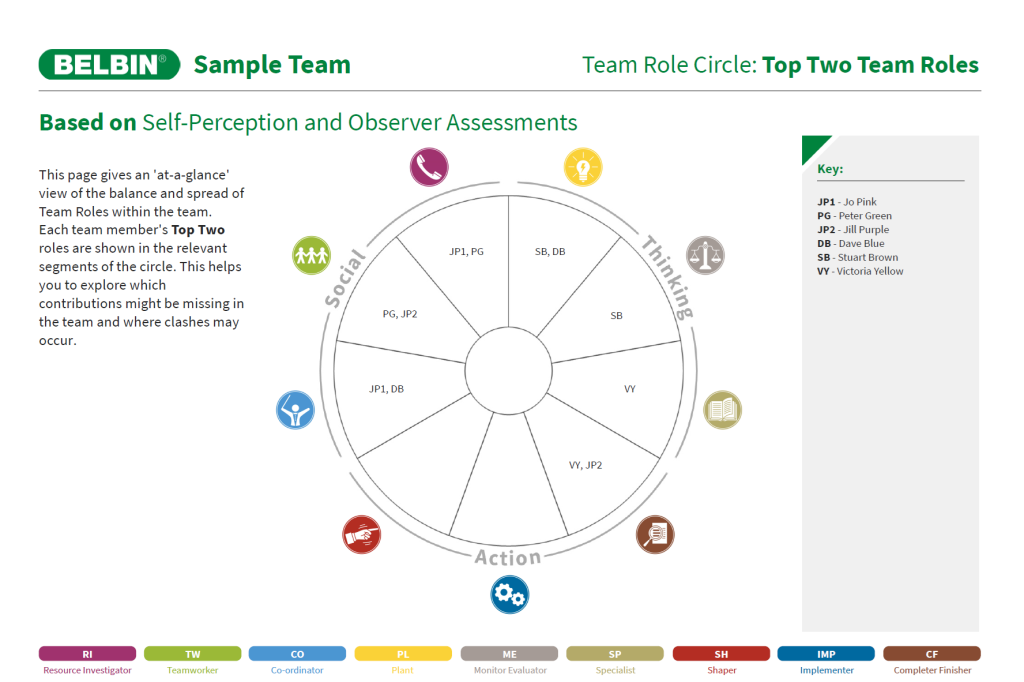
In contrast, Belbin focuses more on how individuals combine, clash and complement one another to form effective teams.
3. Nine Distinct Roles for the Real-World
Belbin identifies nine team roles such as Shaper, Implementer and Teamworker. Each with strengths and allowable weaknesses. It offers a nuanced view of contribution rather than grouping people into a handful of primary types or colours.
4. Allows for Change
We all behave differently depending on the situation. Belbin recognises that our team role preferences can shift as projects, teams or roles evolve. Alternatively, Personality profiles tend to assume we’re relatively fixed in our style.
5. Feedback Matters
Belbin includes optional input from colleagues through Observer Assessments. This provides a 360° view of how others see your contributions. Personality tools typically rely on self-perception only, which may be unintentionally biased.
6. Strengths and Weaknesses are Valued
Every Belbin role comes with “allowable weaknesses” – natural trade-offs that make strengths possible. Whearas, Personality profiles often separate these traits. In contrast, Belbin normalises them as part of the overall behavioural profile picture.
8. The Science Behind Team Roles
Belbin is based on decades of research at Henley Management College, observing real managers in real teams. It’s data-driven and workplace-tested, not purely theoretical.
9. Reducing Friction
By highlighting complementary roles and potential clashes, Belbin helps teams resolve differences constructively. Whereas, a Personality Profile often stops at “you’re different”, without explaining how to work together more effectively.
10. Straightforward Language
Belbin’s role titles are practical and memorable (“Coordinator”, “Completer Finisher”), not abstract concepts or psychological “jargon”. Which makes it easier to discuss and understand.